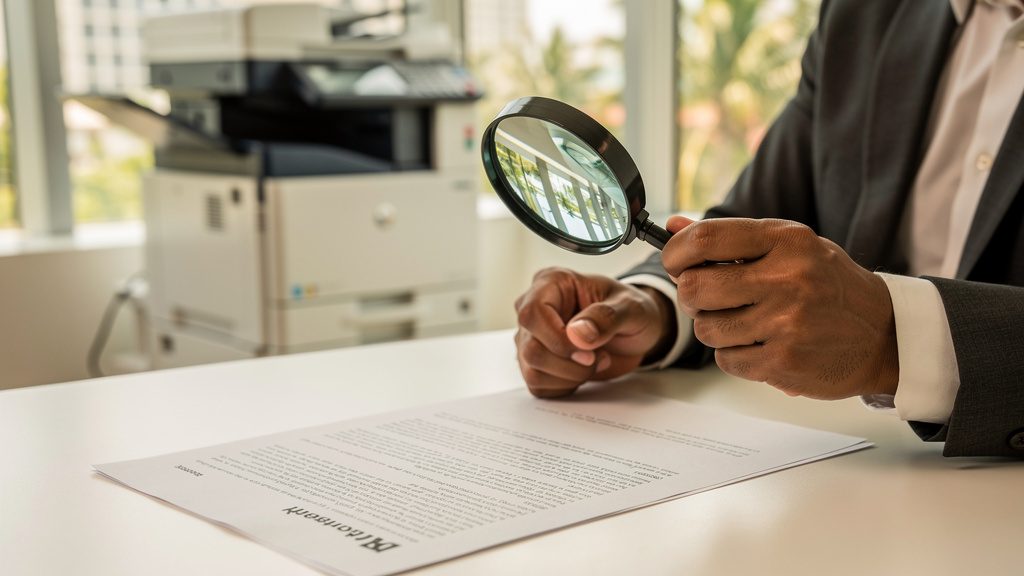
A commercial copier lease is a routine business decision that most office managers in Miami-Dade, Broward, and Palm Beach counties handle a handful of times over the life of a company. That’s exactly why the fine print matters. Copier lease contracts are written by the leasing company, and unless you read closely, or work with a dealer who explains things plainly before you sign, it’s easy to end up locked into terms that cost you money, flexibility, or both.
We’ve reviewed hundreds of lease agreements for businesses across South Florida, and the same handful of problem clauses show up again and again. None of them are illegal. Most of them are legal, standard boilerplate in this industry. But “standard” doesn’t mean “fair to you,” and a little awareness before you sign can save you thousands of dollars and a lot of frustration down the road. If you haven’t already, it’s worth starting with our complete guide to commercial copier leasing in South Florida for the basics on how these leases are structured. Below are five red flags to watch for once you’re actually looking at a contract.
1. Automatic Renewal (Evergreen) Clauses
This is the single most common complaint we hear from South Florida business owners, and it’s almost always tucked into a paragraph near the end of the agreement rather than front and center where you’d expect to see it. An automatic renewal, or “evergreen,” clause states that if you don’t formally notify the leasing company of your intent to cancel within a specific window, often 60 to 120 days before the lease’s end date, the lease automatically renews for another full term, sometimes a full year or longer, at the same or even higher monthly rate.
Here’s why it’s a problem: most businesses don’t track lease-cancellation windows the way they track rent or loan due dates. By the time you remember to look into upgrading your equipment or shopping around, the deadline has already passed and you’re locked in for another 12 to 60 months on a machine that may be outdated or overpriced for your needs. We’ve seen offices in Boca Raton and Pompano Beach get stuck paying for aging equipment for an additional year simply because nobody flagged the calendar in time.
What to ask your leasing provider: Ask directly, “Does this lease auto-renew, and if so, what is the exact notice window and how do I need to submit notice (written letter, certified mail, email)?” A transparent provider will tell you this plainly and, ideally, will proactively reach out to you before that window closes rather than let it lapse silently. If a provider is cagey about answering this question directly, that’s a red flag in itself.
2. Vague or Uncapped Overage and Cost-Per-Copy Rates
Most copier leases in South Florida are structured with a base monthly payment that includes a set number of black-and-white and color copies, with an additional per-copy charge for anything over that allowance. That structure is normal and reasonable. The red flag is when the overage rate isn’t clearly spelled out as a fixed number, when it’s subject to change at the leasing company’s discretion, or when there’s no cap on how high it can climb.
A law firm or medical practice that suddenly has a busy quarter and prints well beyond its allotted volume shouldn’t be blindsided by a per-copy rate that’s double what they expected, or worse, a rate the contract allows the leasing company to adjust with limited notice. We’ve seen agreements where the color copy overage rate was left as “subject to current published rates” rather than a specific number written into the contract, that’s a clause that gives the leasing company all the leverage.
What to look for instead: Every per-copy rate, for both black-and-white and color, should be written as a specific dollar-and-cents figure directly in the contract, along with language stating how long that rate is locked in for. Ask, “Can these rates increase during my lease term, and if so, under what conditions and with what notice?” If your print volume varies seasonally, common for accounting firms around tax season or real estate offices during high closing periods, ask about tiered volume plans that flex with your actual usage instead of penalizing you for growth.
3. Bundled Insurance or Add-On Fees Not Disclosed Upfront
Some leasing contracts include mandatory equipment insurance, “loss and damage waivers,” delivery and installation fees, or administrative charges that are bundled into the paperwork but not clearly broken out or explained during the sales conversation. You agree to what you think is a $200-a-month lease, and then discover the actual monthly draft is $240 once these add-ons are factored in.
Equipment insurance itself isn’t necessarily a bad thing, it can protect you if the copier is damaged, stolen, or destroyed in a fire or storm, which is a real consideration here in hurricane-prone South Florida. The issue is when it’s added without a clear, itemized explanation, or when you’re not given the option to provide proof of your own existing business insurance coverage instead of paying for a duplicate policy through the leasing company.
What to ask your leasing provider: Request an itemized breakdown of every fee in the contract before you sign, not just the headline monthly rate. Ask specifically, “Is there an insurance or damage waiver fee built into this payment, and can I opt out if my business already carries equipment coverage?” A dealer worth working with will walk through every line item with you and won’t get defensive when you ask for the full breakdown.
4. Unclear or One-Sided End-of-Lease Terms
What happens when the lease term ends is often where the most contentious disputes happen, and it’s an area where contracts frequently favor the leasing company. Watch for a few specific issues here:
- Unreasonable return conditions. Some contracts require the equipment be returned in “like-new” condition, packed in original boxes and crating that most businesses discarded years earlier, with the customer responsible for arranging and paying for return shipping.
- Forced upgrade pressure. Sales reps sometimes push hard for an “upgrade” to new equipment as the lease approaches its end, implying it’s the only option, when returning the equipment or negotiating a fair buyout may be better for your budget.
- Restocking or removal fees. Some agreements include a flat fee, sometimes several hundred dollars, simply for the leasing company to pick up equipment you’re returning at the end of the term, a fee that’s rarely mentioned when the lease is first signed.
What to look for instead: Before signing, ask exactly what your options are at lease-end: return, renew, upgrade, or purchase (and if purchase, at what price, fair market value or a pre-set number). Ask whether there’s a removal or restocking fee and get the dollar amount in writing. A business in Wellington considering a five-year lease should know at signing, not at year five, exactly what condition the copier needs to be in and who pays for pickup. Our copier leasing guide for Wellington businesses covers local end-of-lease considerations in more detail.
5. Long Lease Terms With No Early-Termination Option
A 60-month lease can make sense for a stable, well-established business that knows exactly what it needs for the next five years. But businesses change, you might relocate, downsize, merge, close a location, or simply outgrow the equipment faster than expected. The red flag here is a long-term lease that either has no early-termination clause at all, or one that imposes a penalty so steep it functions as a trap: for example, requiring 100% of all remaining payments for the full term, with no reduction for early return of the equipment.
We’ve talked to growing businesses in Homestead and elsewhere in South Florida who wanted to relocate or scale up their equipment mid-lease and found themselves boxed in, either they kept paying for a copier they no longer used, or they paid an early-termination penalty larger than simply finishing out the lease. Neither outcome should happen to a business acting in good faith. For businesses in that part of Miami-Dade County weighing shorter, more flexible terms, our Homestead commercial copier leasing page walks through options built around that kind of flexibility.
What to ask your leasing provider: Before committing to any term longer than 36 months, ask specifically what the early-termination process looks like and request the payoff formula in writing, not a vague reference to “remaining balance,” but the actual calculation. Ask whether the lease can be transferred to another business (useful if you sell or restructure) and whether there’s a buyout option that lets you exit cleanly rather than being stuck making payments on equipment you no longer use. A growing accounting firm in Coral Springs, for instance, might reasonably want a shorter initial term with a clear renewal path rather than locking into five years upfront, our Coral Springs copier leasing page outlines term options tailored to businesses in that situation.
The Bottom Line
None of these five red flags mean copier leasing itself is a bad choice for your business, for most offices across Miami-Dade, Broward, and Palm Beach counties, leasing remains a smart way to access modern equipment without a large upfront capital outlay. The issue isn’t leasing; it’s contracts that aren’t transparent about what happens after you sign.
A reputable, transparent leasing provider will walk through renewal windows, per-copy rates, any bundled fees, end-of-lease conditions, and early-termination terms with you in plain language before you ever put pen to paper, and will put all of it in writing without you having to dig for it. If a provider is unwilling to have that conversation upfront, take that as the biggest red flag of all, and take your business elsewhere.