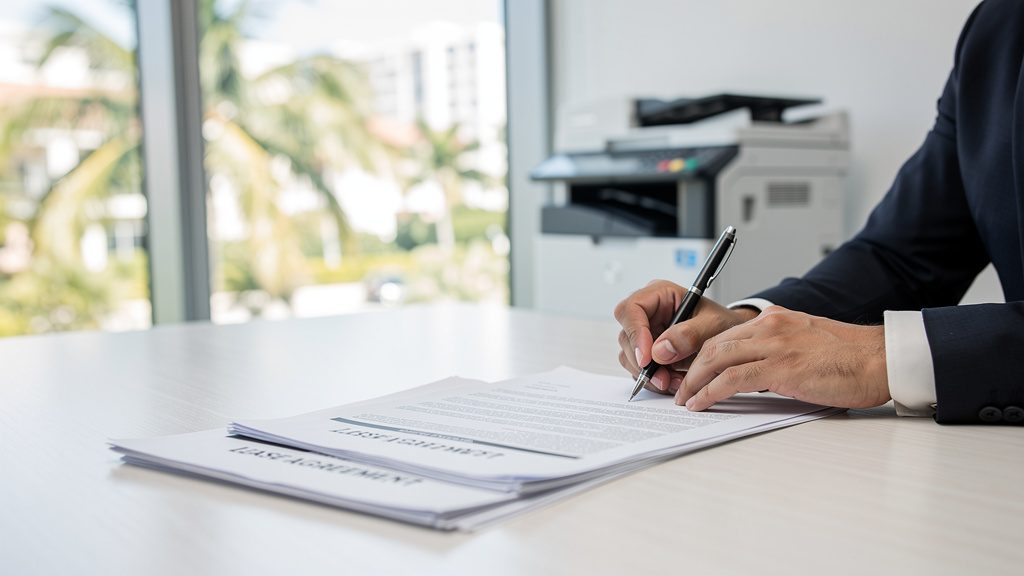
If you’ve started shopping for a commercial copier or multifunction printer for your Miami-Dade, Broward, or Palm Beach County office, you’ve probably already run into a wall of unfamiliar terms. Sales reps toss around phrases like “FMV lease,” “$1 buyout,” “cost-per-click,” and “escalation clause” as if everyone already knows what they mean. Most first-time lessees don’t, and that’s a problem, because the difference between lease structures can add up to thousands of dollars over a typical 36- to 60-month term.
This post breaks down the terminology in plain English. No jargon left unexplained, no fine print skipped. If you want the broader picture of how copier leasing works in South Florida before diving into terminology, our complete guide to commercial copier leasing is a good starting point. This post picks up where that guide leaves off and zooms in specifically on the words printed in your lease contract.
What Is a Fair Market Value (FMV) Lease?
A Fair Market Value lease, almost always shortened to “FMV lease,” is the most common way businesses acquire copiers without buying them outright. Here’s the plain-language version of how it works:
You sign a contract to use a copier for a set term, typically 36, 48, or 60 months. You make a monthly payment for the use of the machine, but you never own it during the lease. At the end of the term, you have three choices: return the copier, upgrade to a newer model and start a new lease, or buy the copier at its current fair market value, meaning whatever the machine is actually worth at that point in its life, not a fixed dollar amount agreed to years earlier.
Because the leasing company retains ownership and is essentially betting the equipment will still have resale or trade-in value at the end of the term, they can offer you a lower monthly payment than they would on a lease that ends in you owning the machine for free. That’s the trade-off in a nutshell: FMV leases keep monthly costs down in exchange for giving up automatic ownership.
FMV leases are popular with offices that expect their printing needs, staff headcount, or technology requirements to change within the next few years. A law firm in Coral Gables that’s growing quickly, for example, might prefer an FMV lease so it can upgrade to a higher-volume machine in three years instead of being stuck with equipment that’s already too small for the practice.
What Is a $1 Buyout Lease?
A $1 buyout lease, sometimes called a capital lease, works differently. In this structure, your monthly payments are calculated so that, by the end of the term, you’ve effectively paid for the full value of the machine. At the end of the lease, you buy the copier for a token amount, usually one dollar, and it’s yours.
Because there’s no guesswork about resale value baked into the pricing, and because you’re paying off the full cost of the equipment, monthly payments on a $1 buyout lease are typically higher than an equivalent FMV lease. Think of it less as a “lease” in the traditional sense and more as a financing arrangement: you’re using monthly payments to purchase equipment over time, with the copier itself serving as collateral, similar to a car loan.
This structure appeals to businesses that already know they want to keep the same machine for the long haul and don’t want to worry about a return-or-buy decision down the road. A busy medical office in Plantation that runs the same volume year after year, for instance, might prefer the predictability of a $1 buyout: higher payments now, but full ownership and no surprises later.
FMV vs. $1 Buyout: The Accounting Difference, in General Terms
Beyond the monthly payment, there’s a meaningful difference in how these two lease types are typically treated on a company’s books. This isn’t tax advice, and every business should confirm details with its own accountant, but at a general level:
An FMV lease is usually treated as an operating lease. Because you never own the equipment and always have the option to walk away at the end of the term, the payments are generally recorded as a straightforward operating expense, similar to rent. This can keep the equipment off your balance sheet as a long-term asset or liability, which some businesses prefer for how it presents their financials.
A $1 buyout lease, on the other hand, is generally treated as a capital lease (also referred to in some accounting frameworks as a finance lease). Since you’re effectively financing a purchase and will own the asset at the end, the equipment and the associated debt typically show up on the balance sheet, much like a piece of financed equipment or a company vehicle. Depreciation also usually becomes relevant, since you’ll own the asset going forward.
Which treatment is more favorable depends on your company’s size, how your accountant structures your books, and what your lender or investors care about seeing on a balance sheet. It’s worth a five-minute conversation with your bookkeeper or CPA before you sign either type of lease.
Other Common Lease Terms Worth Knowing
FMV and $1 buyout describe the overall shape of the lease, but the contract itself will be full of other terms that affect what you actually pay and what happens if things don’t go as planned. Here’s what to look for.
Term Length
This is simply how long the lease runs, most commonly 36, 48, or 60 months in South Florida office environments. Shorter terms mean higher monthly payments but more flexibility to upgrade sooner. Longer terms lower the monthly payment but lock you in longer, which matters more on an FMV lease than a $1 buyout since you may be reassessing your options at renewal.
Cost-Per-Copy (Cost-Per-Click) Charges
Most commercial copier leases include a cost-per-copy or cost-per-click charge, a small per-page fee (often just a fraction of a cent for black and white, more for color) that covers toner, parts, and routine service. This is usually billed based on a meter reading taken monthly or quarterly, and it’s separate from your base lease payment. Understanding your office’s real print volume before you sign is the single best way to avoid an unpleasant cost-per-copy surprise.
Overage Rates
Your lease typically includes an “included” number of copies per month or per quarter as part of the base pricing. Print beyond that allotment and you’ll be billed an overage rate per page, which is sometimes higher than your standard cost-per-copy rate. If your office in Jupiter or elsewhere in Palm Beach County has seasonal print spikes, tax season, year-end reporting, big proposal pushes, ask your dealer to structure the included volume around your actual busy-month numbers, not just your average month.
Escalation Clauses
An escalation clause allows the leasing company to increase your payment or cost-per-copy rate at set intervals over the life of the contract, often annually, tied to a fixed percentage. Not every lease has one, and not every escalation clause is unreasonable, but you should know it’s there and understand the percentage and timing before you sign, rather than discovering it on an invoice eighteen months in.
Early Termination Clauses
This section of the contract spells out what happens if you need to end the lease before the term is up, whether because your business is closing, relocating out of the area, or simply needs different equipment. Early termination often involves paying some or all of the remaining payments, so it’s worth understanding the formula used and asking your dealer whether upgrades mid-term are handled differently than outright cancellations.
Service Level Agreements (SLAs)
An SLA defines how quickly a technician will respond when your copier needs service, commonly a guaranteed response window such as four or eight business hours. It should also spell out what’s covered (parts, labor, toner) versus what isn’t, and whether loaner equipment is provided if your machine needs extended repair. For any office that depends on daily printing, the SLA is just as important as the price.
Which Lease Structure Is Right for You?
There’s no universally “better” option between FMV and $1 buyout; the right choice depends on how your business operates and plans to grow.
An FMV lease tends to make sense if your priority is keeping monthly costs as low as possible and you like the idea of refreshing your technology every three to five years without a separate purchasing decision. Offices with growing or changing print needs, professional services firms, growing medical practices, businesses that expect to relocate or expand, often lean this direction.
A $1 buyout lease tends to make sense if you’ve already settled on the equipment you want, expect your volume to stay fairly stable, and like the certainty of owning the machine outright once the term ends. Businesses with steady, predictable printing needs and a preference for eventually owning their equipment free and clear often prefer this route.
A good local copier dealer should be able to run the numbers both ways for your specific print volume and let you compare the real monthly costs side by side rather than pushing you toward whichever structure pays them the largest commission.
Quick Glossary Recap
- FMV lease: A lease where you don’t own the copier, pay a lower monthly rate, and can buy, return, or upgrade at fair market value when the term ends.
- $1 buyout lease (capital lease): A financing arrangement with a higher monthly payment where you own the copier for one dollar at the end of the term.
- Operating lease: The general accounting treatment typically applied to FMV leases, usually recorded as an ongoing expense rather than a balance-sheet asset.
- Capital/finance lease: The general accounting treatment typically applied to $1 buyout leases, usually recorded on the balance sheet like a financed purchase.
- Term length: The number of months the lease runs, commonly 36 to 60 months.
- Cost-per-copy (cost-per-click): The per-page fee charged for copies beyond the base agreement, covering toner and routine service.
- Overage rate: The per-page charge applied once you exceed your included monthly or quarterly copy allotment.
- Escalation clause: A contract provision allowing scheduled increases to your payment or per-copy rate over the lease term.
- Early termination clause: The terms governing what you owe if you end the lease before the contract period is complete.
- Service Level Agreement (SLA): The guaranteed response time and coverage terms for repairs and maintenance.
Copier lease contracts are full of language that sounds more complicated than it needs to be. Once you understand what FMV, $1 buyout, cost-per-copy, and the rest actually mean, you’re in a much stronger position to compare quotes, ask the right questions, and choose a lease structure that actually fits how your South Florida office operates, not just whatever the sales rep quoted first.